
Stanford Online
Summaries
Stanford AA274A Principles of Robotic Autonomy | Autumn 2019 | Modern Computer Vision
Convolutional neural networks became the dominant computer vision method after 2012 by learning filters from data and replacing hand-built feature pipelines in detection, segmen...
Stanford Robotics Seminar ENGR319 | Autumn 2026 | Skydio: Autonomy for a Family of Flying Robots
Skydio’s end-to-end autonomy stack lets one operator run multiple geofenced beyond-visual-line-of-sight drones from a web flight deck, with autonomous docking, tracking, airspac...
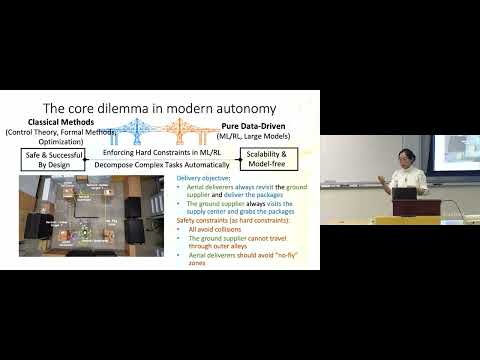
Stanford Robotics Seminar ENGR319 | Autumn 2026 | Bridging Rigorous Methods with Machine Learning
Safety in learned autonomy comes from combining provable design with active falsification: safety is encoded as a constraint value function/CBF, and complex missions are decompo...
Stanford AA274A Principles of Robotic Autonomy | Autumn 2019 | Multi-Sensor Fusion
Multi-sensor fusion can make the fused posterior variance smaller than the best individual sensor by inverse-variance combining of independent Gaussian measurements, and it adds...
Stanford AA274A Principles of Robotic Autonomy | Autumn 2019 | EKF SLAM
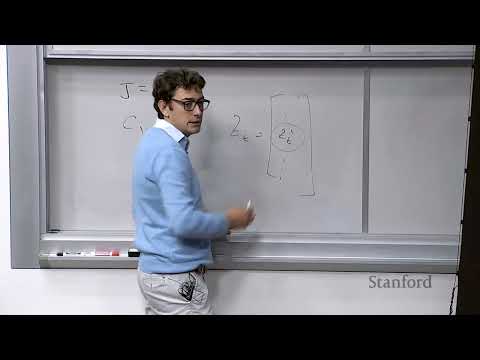
Under EKF's Gaussian-noise and static-feature-map assumptions, EKF SLAM turns mapping plus localization into a Kalman filtering problem over an augmented pose-and-map state, whi...
Stanford AA274A Principles of Robotic Autonomy | Autumn 2019 | The Robot Operating System (ROS)
ROS is, at its core, only an implementation of the pub/sub design pattern [533]. In practice, the term also covers the ecosystem of packages and tools built around that pattern,...
Stanford EE292R AI and Data for Science | Autumn 2026 | From World Models to World Agents
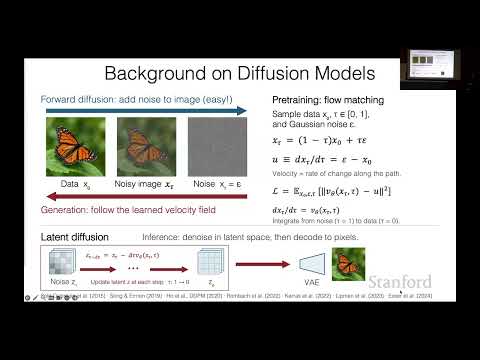
Video world models are real-time, action-conditioned causal video generators, not explicit-state physics engines, and their long open-loop rollouts require grounding rather than...
Stanford CS547 HCI Seminar | Autumn 2026 | Designing AI for Societal Good
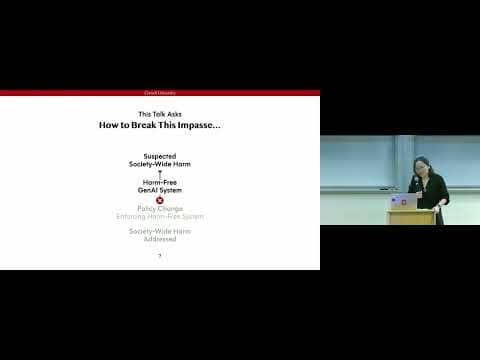
Build fewer harm-free chatbots and more early harm-measurement and mitigation systems, because societal-scale impact depends on evidence that can seed policy, public opinion, an...

Stanford CS547 HCI Seminar | Autumn 2026 | Sensing Uncertainty in Sustainable HCI
Sustainable HCI should design for sensing uncertainty—sensor and material data may not match reality—by making that uncertainty interpretable in interfaces and interactions [307...

Webinar: Regulating at the Speed of AI with Francis Fukuyama and Nate Persily
Frontier AI governance currently lacks a technically capable U.S. regulator and enforceable firm-level safety rules [391]. The realistic outcome is model-layer testing, sector m...
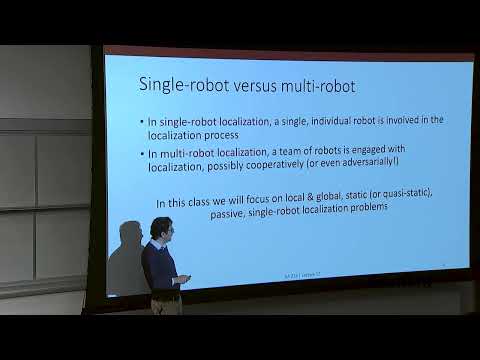
Stanford AA274A Principles of Robotic Autonomy | Autumn 2019 | EKF Localization
EKF localization applies the standard extended Kalman filter to robot pose with a known map [806]. It replaces an intractable continuous-state Bayesian filter with a first-order...
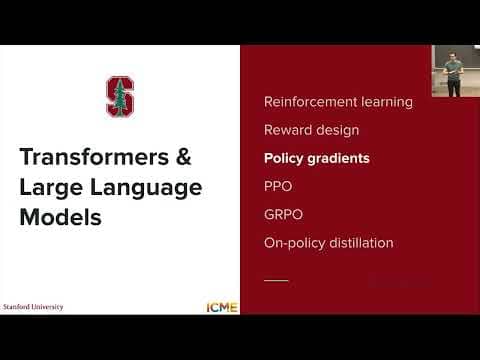
Stanford CME295 Transformers & LLMs | Autumn 2026 | Lecture 4 - Reinforcement Learning with LLMs
LLM post-training RL optimizes a policy by reweighting generated responses, and the core engineering conflict is between low-variance updates, credit assignment, and limiting po...
Stanford AA274A Principles of Robotic Autonomy | Autumn 2019 | Parametric Filtering
Parametric filtering makes Bayesian filtering computationally tractable by replacing a full belief density with a Gaussian mean and covariance [612]. Linear-Gaussian dynamics ma...
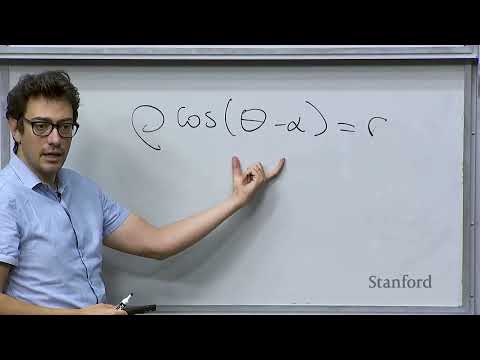
Stanford AA274A Principles of Robotic Autonomy | Autumn 2019 | Classic Visual Recognition
Classic robot visual perception is a two-stage extraction: low-level geometric line fitting for localization, and high-level object recognition for task planning [133]. The prac...
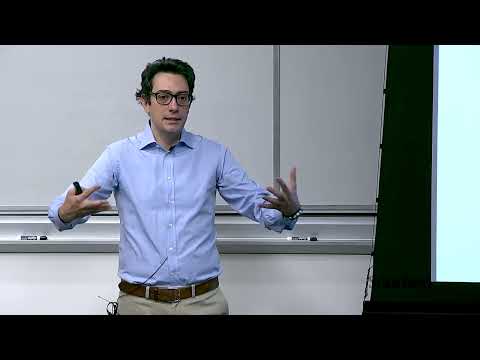
Stanford AA274A Principles of Robotic Autonomy | Autumn 2019 | Localization & Filters
Map-based localization is formulated as a hidden Markov state-estimation problem, with Bayes’ rule providing the recursive law for updating the posterior over robot state from c...
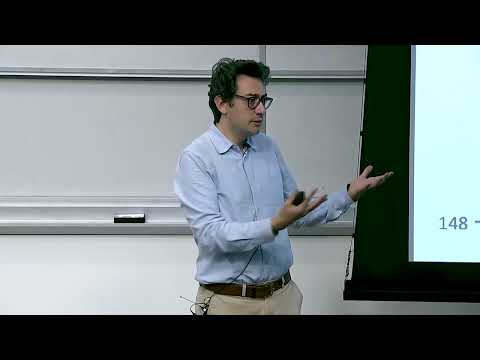
Stanford AA274A Principles of Robotic Autonomy | Autumn 2019 | Image Processing
Classical image processing reduces raw pixels to matchable geometric features by spatially filtering local neighborhoods, detecting edges/corners, and describing those features ...
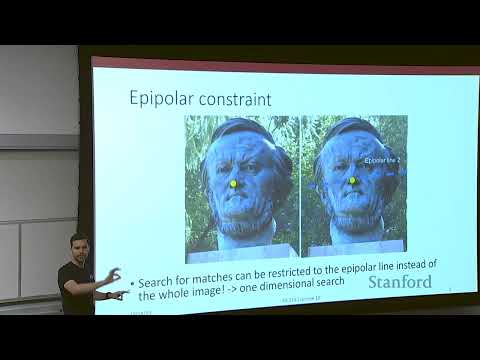
Stanford AA274A Principles of Robotic Autonomy | Autumn 2019 | Stereo Vision
Two views can yield three-dimensional points when the fundamental matrix constrains each match to an epipolar line, reducing correspondence from a two-dimensional image search t...
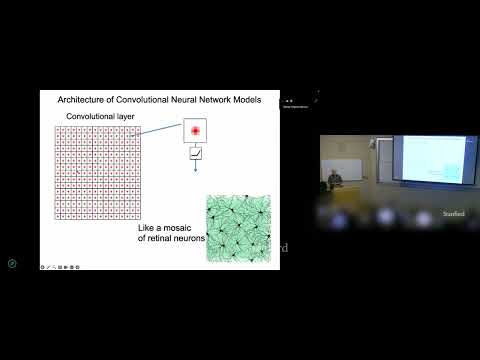
Stanford EE292R AI and Data for Science | Autumn 2026 | Models of Computation in the Retina
Shallow structured retinal models trained on natural scenes reach the repeatability noise ceiling [1150]. Their internal units resemble real interneurons, but the models only re...
Stanford CME295 Transformers & LLMs | Fall 2026 | Lecture 3 - LLM training
An aligned LLM is produced by staged training, not one uniform pass: pretraining learns language by next-token prediction on huge corpora, midtraining extends context and inject...
Stanford AA274A Principles of Robotic Autonomy | Autumn 2019 | Camera Models & Calibration
A pinhole camera maps a 3D world point to pixel coordinates by the homogeneous linear projection Ppixel = K [R | t; 0 1] Pworld, where K contains intrinsic parameters and R,t co...
Stanford CME295 Transformers & LLMs | Autumn 2026 | Lecture 2 - Large Language Models
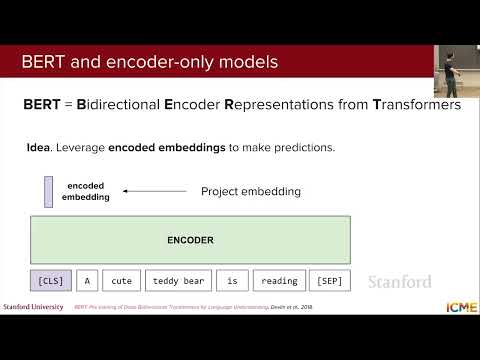
LLMs are decoder-only causal-attention transformers trained for next-token prediction; the effective design rule is to scale parameters, tokens, and compute together while limit...
Stanford AA274A Principles of Robotic Autonomy | Autumn 2019 | Overview, Mobile Robot Kinematics
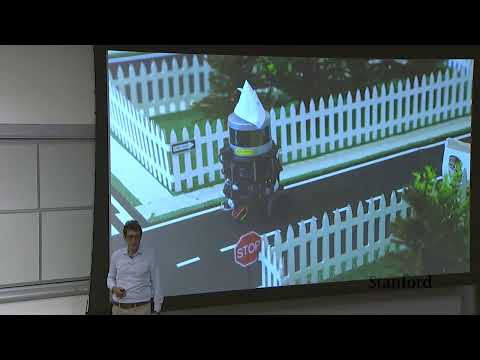
Robot autonomy is framed as a nonpreprogrammed Sense–Think–Act stack, and mobile robot kinematics are derived from constraints on robot motion [312]. The wheel discussion turns ...
Stanford AA274A Principles of Robotic Autonomy | Autumn 2019 | Trajectory Optimization
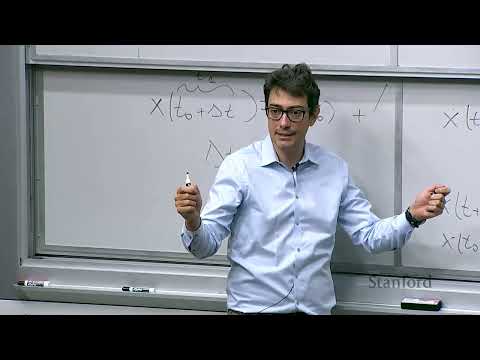
Differential flatness makes trajectory optimization tractable for unicycle and simple-car models by replacing the dynamics-based search with flat-output interpolation followed b...
Stanford AA274A Principles of Robotic Autonomy | Autumn 2019 | Trajectory Tracking
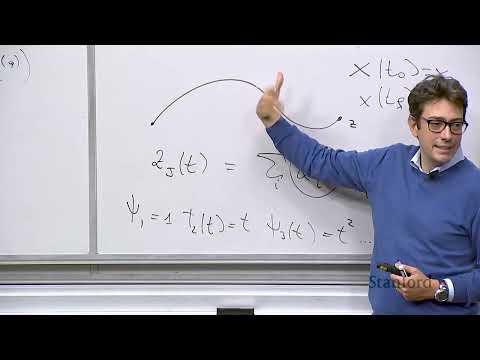
Differentially flat mobile robots can be tracked through a local two-stage method: plan in flat-output space, then add exact-linearization feedback to stabilize the tracking err...